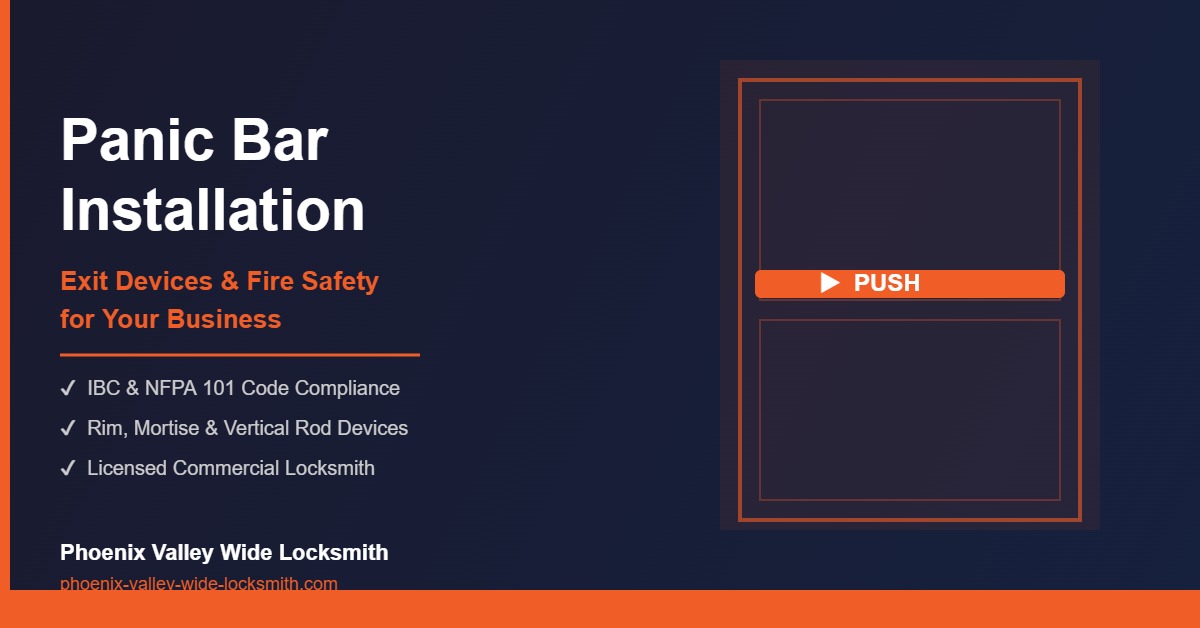
Every commercial building has emergency exits — but not every emergency exit is actually ready for an emergency. Doors secured with knobs, levers, or keyed deadbolts create dangerous bottlenecks the moment a crowd needs to get out. The solution mandated by building code and proven by decades of fire safety data is an exit device, commonly called a panic bar: a horizontal push rail that releases the door latch with a single forward motion — no keys or handles required. In the sections below, you’ll find everything a business owner needs to understand before scheduling a panic bar installation, from code requirements to hardware types to what a licensed locksmith evaluates on-site.
What Is a Panic Bar and How Does It Work?
A panic bar — also referred to as a crash bar or exit device — is a spring-loaded latching mechanism mounted horizontally across an emergency exit door. Pushing the bar inward retracts the latch bolt and allows the door to swing open, even under crowd pressure. No locks to twist, no knobs to fumble with, and no keys required from the inside. The three components every exit device assembly shares:
- The crossbar (touchpad or rail): Mounted at mid-height, 34–48 inches off the floor per ADA guidelines.
- The latch bolt: Engages the door frame strike plate when closed; the crossbar retracts it.
- The backset assembly: Transfers mechanical energy from the push-bar to the latch retraction.
At Phoenix Valley Wide Locksmith, our commercial hardware team has completed panic bar installations across hundreds of openings in Maricopa County. Find us on Google Maps to confirm our service area.
Building Code Requirements for Panic Bar Installation
The International Building Code (IBC) and NFPA 101 establish when panic hardware is mandatory:
- Assembly occupancies (restaurants, theaters, event venues): Required when occupant load exceeds 49 persons.
- Educational occupancies: Same 49-person threshold.
- High-hazard occupancies: Required regardless of occupant load.
Our commercial locksmith services always begin with a code compliance review. Business owners in Scottsdale, Mesa, and across the Valley should verify their local fire marshal’s adopted code edition before every inspection.
Pro Tip: Any change in occupancy use — converting storage into a customer-facing area — may change your hardware requirements. Schedule a commercial door hardware audit whenever a space changes use.
Panic Bars vs. Deadbolt Security: The Right Hardware for Each Door
A deadbolt — keyed from outside and operated by a thumbturn lock inside — is correct for office interiors, server rooms, and storage. Its deep bolt throw resists forced entry. However, a deadbolt on a required egress door is a code violation in most U.S. jurisdictions because it requires deliberate manipulation from the inside.
A panic bar trades exterior key control for guaranteed one-motion interior release. For dual-purpose doors, a rim device with keyed exterior trim preserves compliant egress while allowing controlled entry. Our door hardware specialists evaluate each opening individually. Need lock installation on interior doors at the same time? We can scope both in a single visit.
Types of Exit Devices: A Side-by-Side Comparison
Installing the wrong device type causes alignment problems, door-frame stress, and latch failures. Browse our commercial lock services for a full scope breakdown.
| Exit Device Type | Best Application | Door Compatibility | Security Level | Code Compliant Egress |
|---|---|---|---|---|
| Rim (surface-mount) | Single-door exits, light commercial | Hollow metal, wood | Moderate | ✅ Yes |
| Mortise | High-traffic commercial entries | Heavy-gauge hollow metal | High | ✅ Yes |
| Vertical Rod (top & bottom) | Double doors, no center mullion | Aluminum, hollow metal | Moderate–High | ✅ Yes |
| Concealed Vertical Rod | Glass storefront doors | Aluminum frame | Moderate–High | ✅ Yes |
| Mortise + Deadlocking Latch | High-security egress points | Hollow metal, steel | High | ✅ Yes |
| Standard Deadbolt | Office interiors, storage rooms | Wood, hollow metal | High | ❌ Not on egress doors |
| Thumbturn Lock (interior only) | Residential, interior offices | Wood, fiberglass | Moderate | ❌ Not on required egress |
| Rim w/ Keyed Exterior Trim | Employee exits with exterior access | Hollow metal, wood | Moderate–High | ✅ Yes |
undefined
The Panic Bar Installation Process: Step by Step
- On-site measurement — Door thickness, stile width, and floor clearance determine the right device model.
- Frame and strike preparation — Strike plate position must be precise; misalignment causes latch drag and premature wear.
- Mounting and torque calibration — Fasteners torqued to specification prevent shifting under repeated use.
- Force and function testing — ANSI/BHMA A156.3 requires no more than 15 lbs of push force. Every installation at Phoenix Valley Wide Locksmith is force-gauge verified before sign-off.
- Alarm integration — Integral alarm horns wired to the building’s fire panel or configured to local-only alert.
Retrofitting an older lever handle or thumbturn lock? Our team handles retrofits without full door replacement in most cases. If you also need a lock rekey on other doors, we coordinate both in one visit.
Residential Applications: Home Safety and Accessible Egress
Homeowners with aging family members, young children, or residents with mobility limitations increasingly install residential panic hardware on rear doors and garage entries. These devices eliminate the need to operate a deadbolt or thumbturn lock under stress — a critical home safety consideration. Our residential locksmith team in Phoenix can assess your egress points and recommend the right hardware. If you’re planning broader home security upgrades, this is a natural addition to the scope.
Frequently Asked Questions About Panic Bar Installation
Is panic bar installation required for all commercial buildings? +
Can I install a panic bar on a door that already has a deadbolt? +
What is the difference between a rim exit device and a mortise exit device? +
Do panic bars work on double doors? +
Can panic bars be installed on residential doors for home safety? +
How do I know if my current exit devices are code compliant? +
Schedule Your Commercial Door Hardware Assessment
If your building is approaching a fire safety inspection, undergoing renovation, or has changed occupancy type, a hardware audit is the right first step. A licensed professional locksmith will evaluate every egress opening, document non-compliant hardware, and provide a written scope before any work begins. Contact Phoenix Valley Wide Locksmith to schedule your assessment across Phoenix, Glendale, Scottsdale, Mesa, and surrounding communities. Visit our Google Maps listing to confirm we cover your area. Your emergency exits should work every time — make sure a qualified locksmith has verified them.