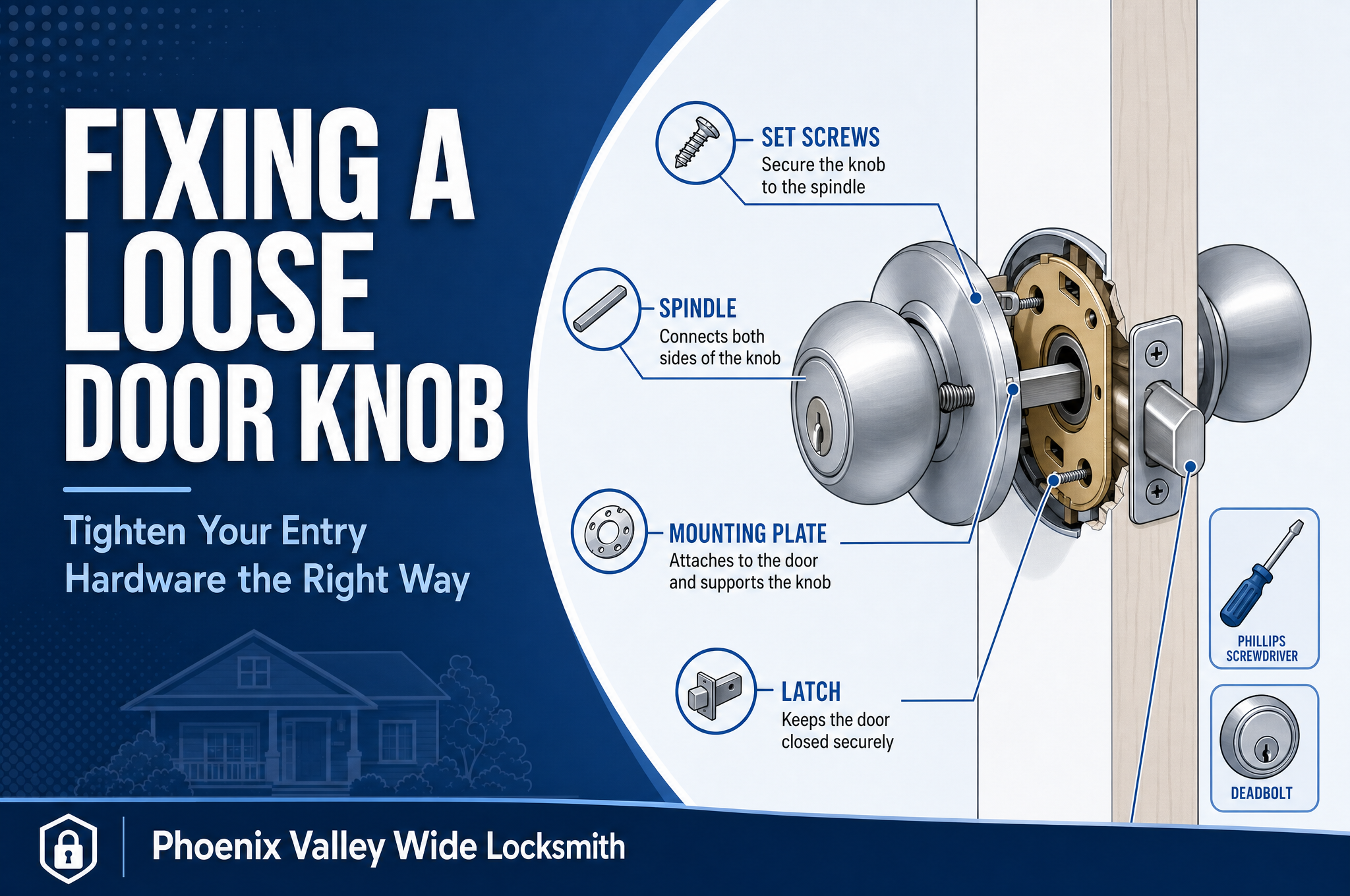
A wobbly door knob is one of the most common hardware problems we find in Phoenix homes — the handle rattles, the latch hesitates, and the whole assembly feels like it could come off in your hand. The solution is usually simpler than most homeowners expect: a screwdriver, the right technique, and a careful check of the parts behind the knob. Keep reading, because in this guide our team at Phoenix Valley Wide Locksmith explains exactly how to tighten your entry hardware and when it makes sense to bring in a professional locksmith.
Why Fixing a Loose Door Knob Matters for Home Safety
Fixing a loose door knob is about more than comfort. When the knob wobbles, the internal fasteners have shifted, and that movement travels through the entire lock assembly. The latch starts missing the strike plate, the cylinder sits off-center, and the door becomes easier to force. Through our extensive work providing residential locksmith services across the Valley, we can tell you that a neglected loose knob is often the first step toward a failed lock — and a weak point in your home safety plan. Desert dust and seasonal door movement here in Arizona accelerate the problem, which is why we recommend pairing this repair with a broader look at your entry, such as a door reinforcement kit.
| Hardware Type | Common Loosening Point | Security Role | Best Application |
|---|---|---|---|
| Keyed Entry Knob | Set screws and spindle | Basic latch security | Side and interior doors |
| Lever Handle | Mounting plate bolts | Basic latch security | Accessibility-focused entries |
| Single-Cylinder Deadbolt | Thumbturn lock assembly | Primary forced-entry resistance | Front and back doors |
| Double-Cylinder Deadbolt | Cylinder housing screws | High resistance, key on both sides | Doors with glass panels |
| Handleset with Deadbolt | Through-bolts behind grip | Combined latch + deadbolt security | Main entry doors |
| Keypad / Electronic Lock | Interior battery housing | Keyless access control | Families and rentals |
| Biometric Deadbolt | Sensor module mount | Fingerprint-verified entry | Tech-forward households |
| Smart Lever + Deadbolt Combo | Adapter plate alignment | Remote-managed home safety | Connected-home setups |
What Causes a Door Knob to Come Loose
Understanding the cause makes the repair stick. These are the three failure points we see most often on service calls.
Worn or Backed-Out Set Screws
Most knobs and levers are held to the spindle by one or two small set screws. Every turn of the handle applies torque to those screws, and eventually they back out. This is the classic cause behind a knob that spins without moving the latch.
A Shifting Mounting Plate
Behind the rose (the decorative ring against the door) sits a mounting plate joined by two through-bolts. If those bolts loosen, the entire assembly rocks on the door face. Older homes around Phoenix often have enlarged screw holes from repeated re-tightening, which makes the plate drift again soon after each fix.
Spindle and Latch Wear
The spindle is the square bar connecting both sides of the knob. When it wears down — or when the latch mechanism gums up with dust — the handle develops play that no screw can remove. In that case the smart move is a hardware swap, and our lock cylinder replacement guide explains how the internal components fit together. A clean lubricant also helps; see our comparison of graphite vs silicone for door locks.
How to Tighten a Loose Door Knob Step by Step
Here is the method our technicians use, adapted for the two knob styles you will find on American doors.
Knobs with Exposed Screws
- Open the door and stabilize it with a wedge so you can work on both sides.
- Locate the two screws on the interior rose plate.
- Hold the exterior knob firmly while you tighten each screw in small alternating turns — alternating keeps the assembly centered on the spindle.
- Check the latch by turning the handle; it should retract fully and snap back without hesitation.
Knobs with Hidden Screws
- Find the release slot or pin hole on the side of the interior knob. Press it with a flathead screwdriver or the tip of a paper clip and slide the knob off the spindle.
- Remove the rose plate by prying gently at the notch on its edge.
- Tighten the exposed mounting bolts, re-seat the plate, and press the knob back on until it clicks.
- Test the thumbturn lock if your hardware includes one — it should rotate smoothly with no grinding.
If a screw spins without gripping, the hole is stripped. Fill it with a wooden toothpick and carpenter’s glue, let it set, and re-drive the screw into the fresh material.
Pro Tip from Our Technicians
After tightening hundreds of knobs across the Valley, we learned this: always tighten with the door open and the latch extended. Tightening against a closed door lets the strike plate mask misalignment, and the knob works itself loose again under normal use. With the door open, you feel exactly how the latch and spindle seat — and the repair holds.
Check Your Deadbolt Security While You Are There
A loose knob is a useful warning light for the rest of your entry hardware. Grab the deadbolt and test it for the same play. Strong deadbolt security depends on a fully extended bolt seating into a reinforced strike — the ANSI/BHMA grading system rates residential hardware by exactly this kind of durability. If your bolt feels loose or short, a professional deadbolt installation corrects it. And if you are ready to move past keys entirely, options like keypad door locks and biometric deadbolt locks eliminate the worn-spindle problem altogether.
When a Professional Locksmith Should Step In
DIY tightening solves most wobbles, but call a professional locksmith when the spindle is visibly worn, the door has sagged out of square, or the knob loosens repeatedly after correct repairs. Those symptoms point to deeper hardware fatigue. Our team handles everything from lock rekeying to full lock changes, and manufacturers like Schlage publish torque and fit specifications that our technicians follow on every installation. You can learn more about our background and training on our About Us page.
Frequently Asked Questions About Fixing a Loose Door Knob
Why does my door knob keep coming loose after I tighten it?
Repeated loosening usually means the screw holes are stripped or the spindle is worn. Fill stripped holes with toothpicks and carpenter’s glue before re-driving the screws. If the wobble returns again, the internal hardware has fatigued and replacement is the lasting solution.
What tools do I need to tighten a loose door knob?
A Phillips screwdriver handles most exposed-screw models. Hidden-screw knobs also call for a flathead screwdriver or a paper clip to press the release pin, plus gentle prying at the rose plate notch. No power tools are needed — hand pressure gives better control over small set screws.
Can a loose door knob affect my home security?
Yes. A loose knob lets the latch sit off-center in the strike plate, which weakens the door’s resistance to force. It also accelerates wear on the cylinder. Tightening the hardware restores proper latch engagement and protects the rest of the lock assembly.
My door knob spins but the latch does not move. What happened?
The set screw that joins the knob to the spindle has backed out, or the spindle itself has sheared. Remove the knob, inspect the square spindle bar, and re-seat the set screw. A worn or broken spindle means the knob assembly should be replaced.
Should I tighten my thumbturn lock the same way?
Yes, the approach is similar. A wobbly thumbturn usually traces back to loose through-bolts on the interior deadbolt plate. Tighten them in alternating turns while holding the exterior cylinder steady, then confirm the bolt extends fully into the strike.
When should I replace the knob instead of tightening it?
Replace the hardware when the spindle shows visible wear, the latch sticks after cleaning and lubrication, or the knob loosens repeatedly despite correct repairs. Upgrading to an ANSI/BHMA-graded knob or adding a deadbolt strengthens the entire entry.
Keep Your Entry Hardware Solid with Phoenix Valley Wide Locksmith
A tight knob, an aligned latch, and a properly seated deadbolt work together as a system — and that system protects everything behind your front door. If your hardware still wobbles after these steps, or you want a trained eye to evaluate your locks, our technicians serve the entire Valley from our location in central Phoenix; you can find us on Google Maps and read what neighbors say about our work. For more ways to strengthen your entry, our guide to door reinforcement kits is the natural next read. Call (480) 448-2088 or visit our contact page to request an installation or a full home security audit — we are ready to help.