Traditional keys get lost, copied without permission, or forgotten at the worst moments — leaving homeowners in Phoenix locked out of their own front doors. Biometric deadbolt locks solve that problem by using your fingerprint as the key, eliminating the weak link of physical keys while keeping your entryway as solid as any high-grade deadbolt. At Phoenix Valley Wide Locksmith, our team has installed and serviced fingerprint-enabled hardware across the Valley, and we’re sharing what actually works, what doesn’t, and what every homeowner should know before upgrading. Keep reading to learn how fingerprint technology compares to standard hardware, where it shines, where it falls short, and how to choose the right setup for your home.
How Biometric Deadbolt Locks Actually Work
A biometric deadbolt lock reads the unique ridges and valleys of your fingerprint, converts that pattern into an encrypted digital template, and matches it against stored authorized prints to release the bolt. Unlike a traditional deadbolt that relies on a cut key and pin tumblers, these locks use a capacitive or optical sensor paired with a motorized locking mechanism. Most quality models still include a physical key override and a keypad backup, so homeowners have three independent ways to enter the home.
Our professional locksmith team has installed these across single-family homes, condos, and short-term rentals throughout the metro area. You can also find us on Google Maps to see our verified location and real homeowner reviews. The best units we’ve serviced consistently pair fingerprint access with Grade 1 or Grade 2 ANSI-rated deadbolts — meaning the hardware itself meets commercial-level strength standards regardless of the electronics.
| Feature | Biometric Deadbolt | Traditional Deadbolt | Keypad Deadbolt |
|---|---|---|---|
| Entry Method | Fingerprint + key/code | Physical key only | PIN code + key |
| Key Duplication Risk | Very low | High | Medium |
| User Management | Up to 100+ prints | Requires rekeying | Shared code risk |
| Power Source | AA batteries (1–2 yr) | None needed | AA batteries |
| Heat Tolerance (AZ sun) | Good (quality models) | Excellent | Good |
| ANSI Grade Available | Grade 1 & 2 | Grade 1, 2, & 3 | Grade 2 & 3 |
The Security Advantages That Matter Most
Fingerprint technology eliminates the two biggest vulnerabilities of traditional hardware: unauthorized key duplication and shared credentials. A key left with a contractor, a babysitter, or an ex-roommate can be copied at any hardware store. A fingerprint cannot. That single shift changes the entire access-control picture for a home.
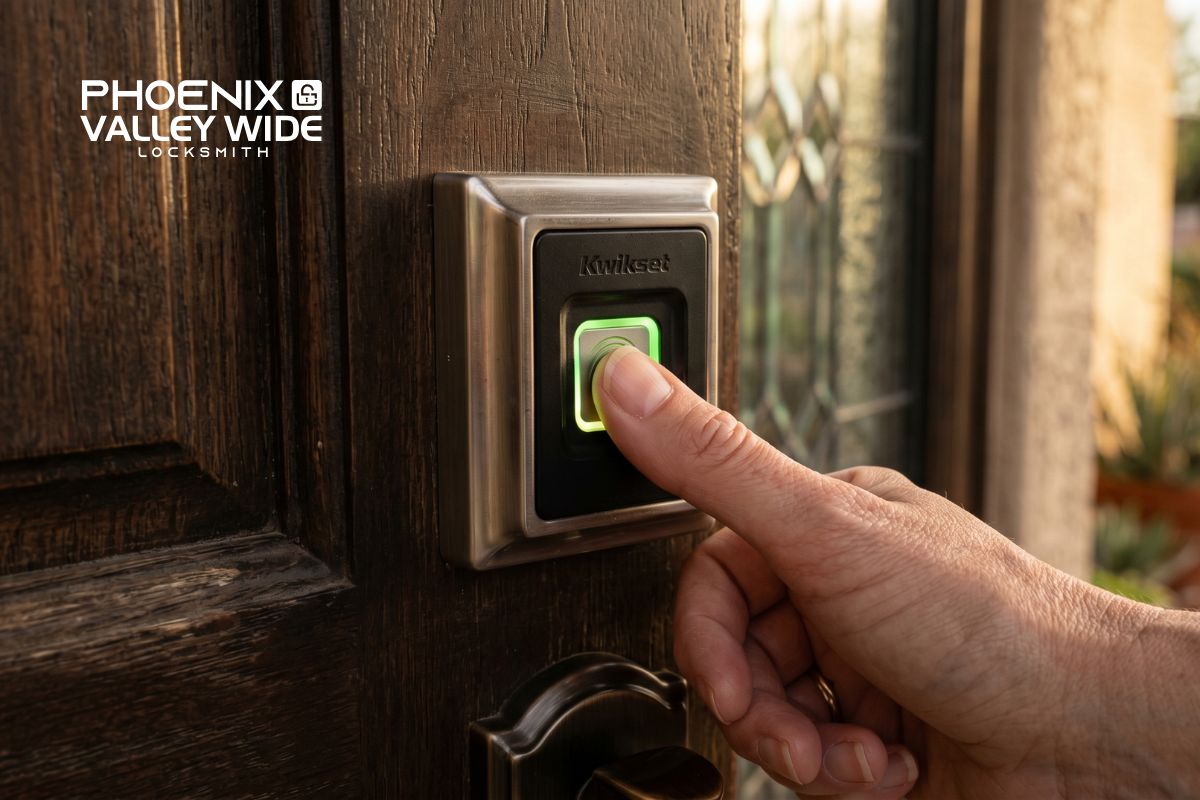
[IMAGE: Insert Image Described Here] A close-up, photorealistic shot of a homeowner’s thumb pressing against the illuminated fingerprint sensor of a modern brushed-nickel biometric deadbolt installed on a dark wooden front door. Warm Phoenix afternoon light catches the polished metal finish, showing the green confirmation LED glowing as the bolt retracts.
From our hands-on experience installing these across Phoenix neighborhoods, here are the real advantages homeowners notice within the first month:
- No more hidden spare keys. The fake rock by the planter is a burglar’s first stop. Fingerprint access ends that habit.
- Audit trails. Premium models log who entered and when — useful for families with teens, caregivers, or service providers.
- Instant revocation. Remove a user’s print in seconds. Compare that to changing locks or rekeying hardware after losing a key.
- Lockout prevention. Your finger is always with you. Forgotten keys become a non-issue.
- Grade 1 strength available. Top-tier biometric units match the raw deadbolt security of commercial-grade mechanical locks.
Our licensed technicians serving the Phoenix residential market have seen biometric installs dramatically reduce lockout service calls for the homes that adopt them — which says a lot about the practical home safety benefit beyond the spec sheet.
The Honest Drawbacks of Fingerprint Technology
No lock is perfect, and responsible recommendations mean being transparent about limitations. We’ve serviced enough failed units across the Valley to know where the weak points live — and which scenarios warrant a different solution.
Environmental Sensitivity
Phoenix summers test every piece of exterior hardware. Cheap biometric sensors can struggle with direct afternoon sun exposure, dust buildup from monsoon season, or thermal expansion inside the housing. Quality brands engineer around this with IP65-rated enclosures and wider operating temperature ranges, but entry-level models often don’t. Our installation experts always recommend weather-rated units for west-facing and south-facing doors.
Wet, Dirty, or Injured Fingers
A cut, a bandage, grease from yard work, or just wet hands after watering plants can cause a sensor to reject a valid print. This is why every lock we install includes a backup — usually a keypad code and a physical thumbturn lock on the interior side. Homeowners who rely solely on the fingerprint without learning the backup access method end up calling for lockout help they didn’t need.
Battery Dependency
Electronics need power. A dead battery on a biometric deadbolt means fallback entry only — either the override key or a 9V external battery terminal on better models. We coach every client through battery replacement during installation and recommend marking a calendar reminder.
Spoofing Concerns — Context Matters
Consumer-grade optical sensors can, in theory, be fooled by high-effort attacks using lifted prints. In practice, this isn’t how residential burglaries happen — criminals kick doors, break windows, or exploit unlocked entries. Still, for households with elevated security needs, capacitive sensors with liveness detection are worth the upgrade. Our commercial security team recommends those specifically for high-value properties.
Pro Tip From Our Field Technicians
After years of installing fingerprint hardware across the metro area, here’s the single piece of advice we give every homeowner: enroll at least two fingers per authorized user, on both hands. Most people enroll one thumb and walk away. Then they cut that finger gardening, or their hands are full of groceries, and they’re stuck. Enrolling the index finger of your dominant hand, plus the thumb of your non-dominant hand, gives you redundancy that matches how you actually approach your door in real life. It takes an extra minute during setup and eliminates the majority of “won’t-read” service calls we get.
Also — always test the mechanical key override the day the lock is installed, then once per season. A backup you’ve never used is a backup you can’t count on. Our mobile service team across Phoenix regularly handles calls from homeowners whose override key never fit properly because nobody verified it at install time.
Choosing the Right Biometric Deadbolt for Your Home
Not every home needs the same solution. A single-entry townhome has different needs than a four-door house with a pool gate and a garage service door. Our residential specialists walk homeowners through a short checklist before recommending hardware:
- Door material and prep. Solid wood, fiberglass, and metal doors all accept biometric deadbolts, but the strike plate reinforcement matters more than the lock itself. We always upgrade to 3-inch screws into the framing stud.
- Sun exposure. West-facing doors in Phoenix need weather-sealed units. East-facing doors have more flexibility.
- Number of users. A family of four needs different capacity than a rental property with rotating guests.
- Integration needs. If you want smartphone control, geofencing, or integration with a security system, you’ll need a Wi-Fi or Z-Wave enabled model — not every biometric lock has it.
- ANSI grade requirement. For primary entry doors, we recommend Grade 1 or Grade 2 only. Grade 3 is acceptable for interior or low-traffic secondary doors.
Our team brings multiple brands and options to every consultation so homeowners can see the hardware, feel the finish, and test the sensor before committing. Phoenix Valley Wide Locksmith has served the metro area for years, and we’re fully licensed, insured, and bonded for every residential and commercial install we perform. Homeowners across Phoenix have left consistent positive reviews on Google describing transparent recommendations and clean installations — reputation we’ve built one door at a time.
Common Mistakes We See Homeowners Make
The worst biometric lock experiences almost always trace back to one of these avoidable errors. Our service technicians have documented these patterns across hundreds of Phoenix installations.
Buying the cheapest unit on the shelf is the most common mistake. Sub-$100 biometric locks typically use lower-grade sensors, weaker bolts, and plastic internal gearing that fails under Phoenix temperature swings. The hardware itself is what stops an intruder — the fingerprint reader just tells the hardware when to move.
Skipping the strike plate upgrade is the second most common. The lock can be military-grade, but if the strike plate uses the ¾-inch screws that came in the box, a solid kick defeats the entire system. Our installation standards always include 3-inch screws into the king stud — a small detail that multiplies real-world deadbolt security.
Finally, never enrolling a second authorized user is a setup most homeowners regret. If one person travels and the battery dies, the rest of the household is stuck. Always enroll a second household member, a trusted neighbor, or both.
Frequently Asked Questions
Are biometric deadbolt locks really safer than traditional locks?
What happens if the battery dies?
Can Phoenix heat damage a fingerprint lock?
How many fingerprints can be stored?
Do biometric locks work during a power outage?
Can a professional locksmith install my biometric deadbolt?
Making the Right Call on Fingerprint Technology
Biometric deadbolt locks aren’t a gimmick — they’re a genuine upgrade over traditional hardware when installed correctly and matched to the right door. The technology addresses real weaknesses that have existed in residential security for decades, from lost keys to unauthorized duplication to the hassle of rekeying every time a tenant moves or a relationship changes. For most Phoenix homeowners weighing the upgrade, the question isn’t whether the technology works — it’s whether the specific unit, door, and installation meet the standard your household actually needs.
If you’re still comparing options, you might also want to read our guide on rekeying versus replacing your locks to see how biometric hardware fits into the broader picture of home deadbolt security decisions.
Phoenix Valley Wide Locksmith is fully licensed, insured, and bonded, with technicians trained on every major biometric brand on the market. We’ve built our reputation across the Valley through transparent consultations, clean installations, and strong Google reviews from homeowners who wanted hardware done right. Come visit our location on Google Maps to see verified reviews, photos of recent work, and confirmed service hours from neighbors across Phoenix.
Ready to upgrade your front door with a biometric deadbolt matched to your home, your door, and Phoenix conditions? Contact our team for a no-pressure consultation, or stop by our Google Maps listing to message us directly and see what other homeowners are saying. Our licensed locksmiths are ready to walk you through the best hardware for your setup and handle the install from start to finish.