If your Phoenix business still relies on traditional keys to control who enters your building, you’re operating with a significant security gap. Access control systems eliminate that gap by replacing mechanical keys with programmable, traceable, and remotely managed credentials — giving you real authority over every door, every time.
Many business owners across the Valley discover the problem too late: a former employee still has a key, a lock was never rekeyed after a break-in, or there’s simply no record of who entered the back office after hours. These aren’t hypothetical risks — they’re the exact scenarios our commercial locksmith team resolves week after week across Phoenix.
At Phoenix Valley Wide Locksmith, we’ve spent years working alongside local business owners — from small retail shops in Arcadia to multi-unit office complexes in Downtown Phoenix — helping them transition from outdated key systems to fully integrated digital access solutions. You can find us on Google Maps and see exactly why so many Phoenix businesses trust us with their security infrastructure.
This article breaks down how modern access control works, what it replaces, which system fits your operation, and what the installation process actually looks like — so you can make a confident, informed decision.
Why Traditional Keys Are No Longer Enough for Commercial Properties
There’s nothing inherently wrong with a well-installed deadbolt security lock on a residential front door. But in a commercial environment with multiple employees, vendors, contractors, and shift changes, a physical key becomes a liability rather than a security measure.
The fundamental problem is this: keys duplicate, keys get lost, and keys leave no trail. When an employee leaves your company — voluntarily or not — you have no guaranteed way to ensure their key is returned. Rekeying every affected lock is the right call, and it’s a service our commercial locksmith specialists perform regularly. But rekeying alone doesn’t solve the underlying structural issue: you have no record of who used which door at what time.
Access control systems solve this at the root. Instead of issuing a cut key, you issue a credential — a PIN, a proximity card, a mobile app, or a biometric scan. That credential is tied to a specific person, with specific permissions, active during specific hours. When that person leaves your company, you deactivate their credential from a dashboard. No locksmith visit required. No question about whether they made a copy.
In Phoenix’s commercial market — where the construction, healthcare, hospitality, and logistics sectors demand both flexibility and accountability — this level of control is no longer a luxury. It’s a baseline expectation.
How Access Control Systems Work: The Core Components
Understanding the technology helps you ask the right questions before installation. Every access control system — regardless of brand or complexity — is built from the same four functional layers.
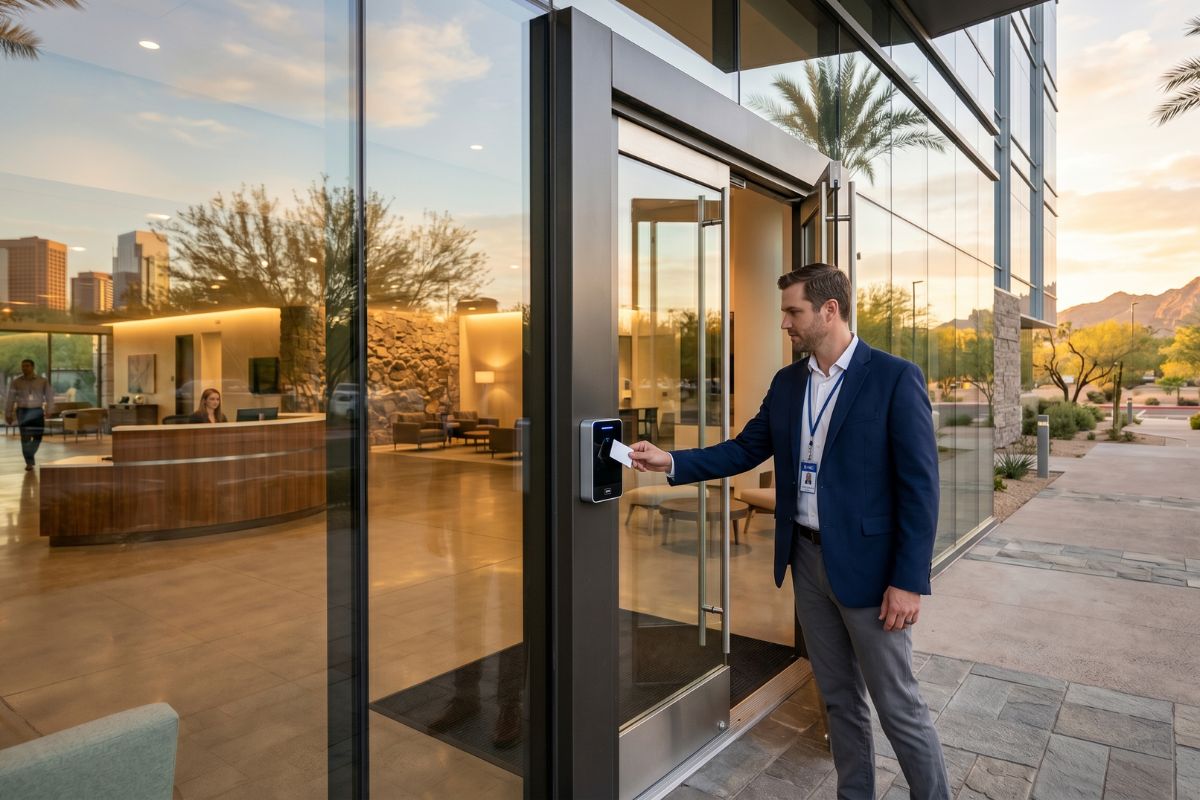
The credential is what the user presents: a key fob, a card, a PIN on a keypad, a fingerprint, or a smartphone using Bluetooth or NFC. The credential is enrolled in the system and tied to permissions.
The reader is the device mounted at the door that interprets the credential. Readers communicate with the controller, which is the brain of the system. The controller checks the presented credential against its database and decides whether to grant or deny access.
The locking hardware executes the decision. This is where our door hardware installation expertise comes in — the locking mechanism must be correctly matched to the door type, frame material, and traffic volume. A heavy-duty commercial door requires different hardware than a lightweight interior office door.
The management software ties everything together. From a browser or mobile app, you can add or remove users, set schedules, view access logs, receive alerts, and lock or unlock any door remotely.
| System Type | Best For | Credential | Remote Mgmt | Audit Logs | Security Level |
|---|---|---|---|---|---|
| Standalone Keypad Lock | 1–2 doors, small offices | PIN code | No | No | Basic |
| Electronic Deadbolt | Storage rooms, back offices | PIN / Key fob | Some models | Limited | Moderate |
| Wired Card Access System | 5–50 doors, commercial | Proximity card / Fob | Yes | Full | High |
| Wireless Networked System | Retrofit buildings | Card / Fob / PIN | Yes | Full | High |
| Mobile Credential System | Tech companies, high turnover | Smartphone (BLE/NFC) | Yes — cloud | Full | High |
| Biometric Access System | Server rooms, pharma, finance | Fingerprint / Face | Yes | Full + Identity | Highest |
| Master Key + Traditional Locks | Low-risk interior doors | Physical key | No | None | Low |
Choosing the Right System for Your Phoenix Business
Not every business needs the same solution. We help our clients match their system to their actual security requirements — not the most expensive option, and not an underpowered one.
Standalone Keypad and Electronic Locks
For single-door applications — a back office, a server room, a storage unit — a standalone electronic lock with a programmable keypad is often the most practical starting point. These units combine the reader, controller, and locking hardware in a single device and require no network connection to function.
Our lock installation team regularly installs standalone electronic deadbolts for small businesses that want to eliminate physical keys from one or two high-risk access points without committing to a full networked system. A quality electronic deadbolt paired with a reinforced strike plate provides strong baseline security for interior doors.
Networked Card Access Systems
For businesses with five or more doors, multiple employees, or compliance requirements, a networked card access system is the professional standard. Each door has its own reader and electronic lock hardware. All readers connect — wired or wirelessly — back to a central controller, which syncs with cloud or on-premises management software.
This is the architecture used in medical offices, law firms, multi-tenant commercial buildings, and distribution centers throughout the Phoenix metro. Our commercial security installations in this category typically involve a combination of proximity card readers at main entry points and PIN keypads at interior sensitive areas.
Mobile Credential and Smart Access Systems
The newest generation of access control uses smartphones as credentials. Employees receive a digital credential to their phone via an app. They tap or wave their phone at a Bluetooth or NFC-enabled reader to unlock the door — no card, no fob, no PIN to forget.
Mobile credential systems integrate with HR and identity platforms, making onboarding and offboarding employees significantly more efficient. If your business is scaling or has high turnover, this architecture reduces administrative overhead considerably. Our smart lock installation technicians are trained and certified on the leading platforms in this category.
Biometric Access Systems
Fingerprint, retina, and facial recognition readers provide the highest credential security because the credential literally cannot be shared or duplicated. Biometric systems are the right call for server rooms, pharmaceutical storage, financial back offices, and any space where regulatory compliance demands a non-transferable access credential.
We integrate biometric readers with existing door hardware as part of our broader commercial locksmith services — they don’t require replacing your entire door infrastructure.
The Role of Door Hardware in a Successful Access Control Installation
One of the most common mistakes businesses make when purchasing access control systems is focusing exclusively on the software and readers while treating the door hardware as an afterthought. In our experience, the physical locking mechanism is where most vulnerabilities actually live.
An access control reader is only as secure as the lock it controls. A magnetic lock, for example, holds the door with significant force — but if the door frame isn’t reinforced, a determined intruder bypasses the reader entirely by attacking the frame. Similarly, a poorly installed electric strike on a hollow-core door provides almost no real resistance.
Our installation process begins with a door audit. We evaluate the frame, hinges, existing lock prep, door material, and traffic pattern before recommending any hardware. For high-security applications, we pair our access control installations with high-security lock hardware that includes reinforced strike plates, anti-pry guards, and concealed cable channels.
Where a thumbturn lock configuration is appropriate — such as a fire-rated exit door that must allow egress without a credential — we configure the hardware to meet both the access control requirement and the life safety code simultaneously.
Pro Tip: Always verify that your access control hardware meets UL 294 (the standard for access control system units) and that any electric locking device on a fire-rated door is listed for that application. In Phoenix, inspections from the local fire marshal can flag non-compliant hardware — and the liability exposure is not worth cutting corners.
What the Installation Process Looks Like
When a Phoenix business contacts us about access control, our process follows a consistent sequence that minimizes disruption to your operation.
Site assessment: We walk the property, identify every door that needs to be controlled, assess the existing hardware and wiring infrastructure, and document the layout. This assessment drives the system design.
System design: We specify the readers, controllers, locking hardware, credentials, and software that match your access points, user count, and budget. We present this as a written proposal — no surprises.
Hardware installation: Our licensed technicians install all door hardware, run conduit and cabling (or configure wireless connections), mount readers, and install the controller panel. We coordinate with your electrician if power requirements exceed low-voltage scope.
Programming and enrollment: We configure the software, create user credentials, set schedules, and test every door before we leave. Your team receives a walkthrough on the management interface.
Ongoing support: Access control systems need periodic maintenance — firmware updates, battery replacements in wireless readers, credential audits, and lock mechanism servicing. Our maintenance and repair services keep your system performing correctly between installation and any future expansion.
We carry all required licensing and insurance for commercial security work in Arizona. Every installation is backed by our parts and labor warranty, and our technicians carry verifiable ID — we require proof of authorization before accessing any secured area.
Common Access Control Mistakes Phoenix Businesses Make
Even with a quality system, poor implementation undermines the security outcome. These are the patterns we see most often in businesses that come to us after a prior installation failed to deliver.
Installing readers but ignoring the doors themselves. A card reader on a weak hollow-core door with a standard residential lock does not create a secure access point. The hardware must match the threat level of the space.
Not setting time-based access restrictions. The system lets you define exactly when each credential is active. If you don’t configure time windows, a terminated employee’s card might still work on a Sunday night. Always set schedules.
Skipping the audit log review. One of the most valuable features of any networked access control system is the access log. Reviewing it regularly reveals tailgating patterns, failed access attempts, and unusual after-hours entry — before those patterns become incidents.
Failing to plan for emergency egress. Life safety codes require that occupants can exit the building without a credential during an emergency. Access control hardware must be selected and configured accordingly. Our team ensures every installation is compliant with applicable codes.
If any of these sound familiar from your current setup, our security consultation can identify the gaps and prioritize the fixes.
Frequently Asked Questions: Access Control Systems in Phoenix
Making the Right Call for Your Business Security
Choosing and implementing the right access control system is a decision with long-term consequences for your business. Done well, it reduces security incidents, simplifies compliance documentation, and gives your operations team real-time visibility into who is moving through your facility. Done poorly, it creates false confidence while leaving the actual vulnerabilities untouched.
The businesses we serve across Phoenix — from Scottsdale medical offices to Tempe tech companies to Glendale warehouses — share a common thread: they wanted a professional who would assess their actual environment, not just sell them a product. That’s what our Phoenix Valley Wide Locksmith team brings to every commercial engagement. With years of hands-on experience in commercial security, certified technicians, and a track record reflected in our verified reviews, we approach each installation as a long-term security partnership.
If you’re considering upgrading your business security infrastructure, our article on commercial lock rekeying and master key systems is a useful next read — it covers how access hierarchy works across multi-tenant and multi-door properties, which pairs directly with the access control architecture discussed here.
You can visit our local listing on Google Maps to read verified reviews from Phoenix business owners who have gone through this exact transition, or reach out to our team directly through our contact page to schedule your on-site assessment.
Contact Phoenix Valley Wide Locksmith today to get your business security audit scheduled — and take the first real step toward full control of who enters your property.